What Is My Current Dasha? How to Find Out Which Mahadasha You're In
Find your active Mahadasha and Antardasha using exact birth Moon coordinates and Parashari Vimshottari timing rules.
If you’ve ever browsed a Vedic astrology forum, you’ve likely stumbled upon endless talk of planetary periods shaping a person’s life journey. Figuring out what my current Dasha feels confusing at first, especially with unfamiliar Sanskrit terms scattered everywhere. This guide breaks down exactly how to identify your current Mahadasha, what it means, and why the details of your birth matter so much in getting an accurate answer.
What Is a Mahadasha and Why Does It Matter in Vedic Astrology?
A Mahadasha represents a major planetary period, a chapter of life traditionally associated with a specific ruling planet’s influence. Each of the nine grahas governs its own Mahadasha, lasting anywhere from six to twenty years.
This concept sits at the heart of the Vimshottari Dasha system, the most widely used timing method in Vedic astrology. Practitioners use it to frame which planetary energies are considered dominant during a given stretch of someone’s life.
How to Find Your Current Mahadasha From Your Birth Details
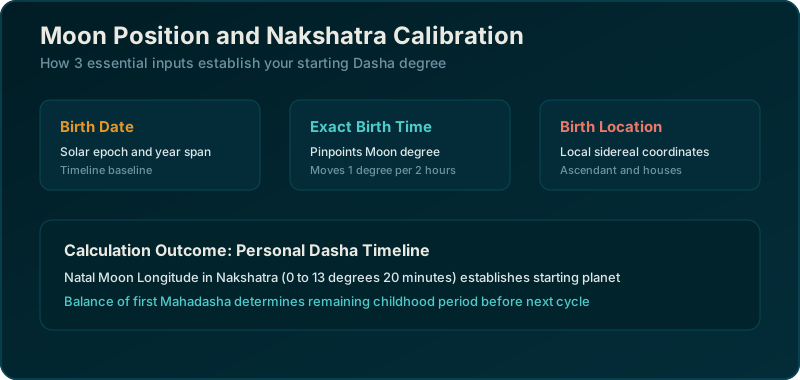
Your current Mahadasha is calculated starting from your exact birth Moon position, not from your birth date alone. The Moon’s placement within a specific Nakshatra at the moment of your birth determines where your personal Dasha sequence begins.
From that starting point, the sequence proceeds in a fixed planetary order, and simple arithmetic based on your age determines which Dasha period you’re currently experiencing.
What Information Does a Dasha Calculator Need?
A reliable Dasha calculator requires three essential pieces of information: your birth date, your precise birth time, and your birth location. Missing or approximate details can shift your results meaningfully.
| Input | Why It Matters |
|---|---|
| Birth Date | Establishes the overall timeline |
| Birth Time | Pinpoints exact Moon position |
| Birth Location | Adjusts for local sidereal time |
Without all three, the Dasha calculation loses the precision needed for a trustworthy result.
How Vimshottari Dasha Determines Your Planetary Period
The Vimshottari Dasha system assigns fixed durations to each planet: Ketu, Venus, Sun, Moon, Mars, Rahu, Jupiter, Saturn, and Mercury, cycling in that specific order across a total 120-year span.
This structured sequence means every person’s Dasha timeline follows the same planetary order, just starting from a different point based on their unique birth Nakshatra placement.
How to Identify Your Current Antardasha
Within every Mahadasha sits a smaller sub-period called an Antardasha, following the same nine-planet sequence but compressed into a shorter timeframe proportional to the main period’s length.
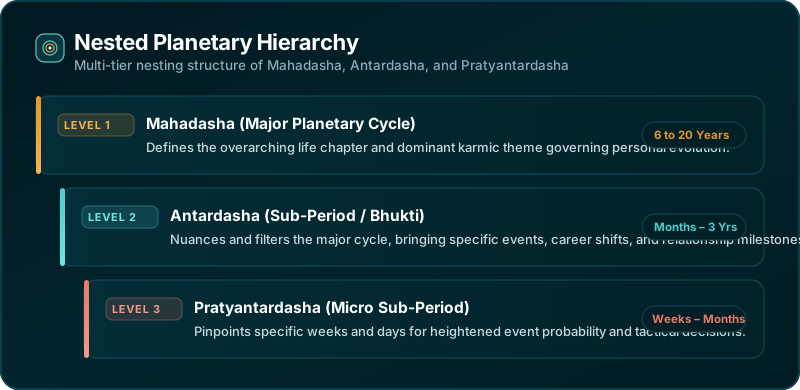
Identifying your current Antardasha adds a layer of nuance beyond just knowing your Mahadasha, since these sub-periods are traditionally read as modifying or coloring the broader planetary theme.
What Your Mahadasha Start and End Dates Tell You
Every Mahadasha carries specific start and end dates unique to your birth chart. These markers let you see exactly how far into your current period you are, and how much time remains.
Knowing these Mahadasha dates also helps you anticipate upcoming transitions, since many people find the shift between planetary periods worth tracking closely.
Why Your Birth Time Can Change the Current Dasha
Even a difference of a few minutes in recorded birth time can shift your Moon’s position enough to change your starting Nakshatra, and therefore your entire Dasha sequence.
This sensitivity is why astrologers emphasize accurate birth time above almost everything else. If your recorded time feels uncertain, double-checking it against birth certificates or hospital records is worthwhile.
How to Read the Planetary Period Shown in Your Results
Most Dasha calculator tools display results as a simple planet name alongside a date range, such as “Jupiter Mahadasha: 2019–2035.” Reading this correctly just means matching today’s date against that range.
If you’re also curious about the smaller sub-period, look for a second planet name nested inside, representing your current Antardasha within that broader Mahadasha window.
What to Check When Your Calculated Dasha Does Not Match Another Source
Discrepancies between two Dasha calculator results usually trace back to differences in birth time accuracy, Ayanamsha settings, or rounding methods used by different software platforms.
Before assuming an error, verify that both sources used identical birth details. Even a slight mismatch in recorded birth time can produce visibly different Mahadasha starting points.
Conclusion
Answering what is my current Dasha comes down to precise birth details and an understanding of how the Vimshottari Dasha sequence unfolds over a lifetime. Once you know your Mahadasha and its nested Antardasha, you have a foundational timeline many Vedic astrology practitioners use for deeper interpretation. Keep your birth details accurate, and your current Mahadasha result will stay reliable and consistent across tools.
Calculate Your Active Dasha Now
Discover which planet is influencing your life path and unlock your personalized astrological timeline.
Open Free Dasha Calculator →